AI & MCP: From the chaos of multiple connections… to the simplicity of MCP
by Justine Parmentier, Business Developer
AI & MCP: From the chaos of multiple connections… to the simplicity of MCP
Recap of the conference presented by Vivian Delplace at the IAKA trade show (Namur): Agentic AI and the Model Context Protocol (MCP).
Vivian, our CTO, had the pleasure of presenting a conference on the future of AI in business.
The objective? To show how we can overcome the current limitations of AI assistants to create true intelligent systems capable of acting autonomously and performing more and more actions.
Current limitations of AI in business
To illustrate this problem, Vivian started with the example of Sophie, a professional who spends two hours every morning performing repetitive tasks:
- copying data from CRM to Excel,
- pasting it into ChatGPT to analyze it,
- manually reformulating the responses,
- then putting the insights back into the CRM.
Result? Ten hours lost per week, copy-paste errors, lost context between tools, and missed business opportunities.
This situation reflects a well-known reality: AI often remains isolated in a chat window, without real connection to business tools like CRM, ERP, or simply email. This disconnection leads to considerable loss of efficiency and explains why so few AI projects actually make it to production.
The solution: the Model Context Protocol (or MCP)
What if AI could directly talk to your tools? This is exactly what MCP enables, a universal bridge between AI and enterprise systems.
"To make the concept accessible, I used a simple analogy: MCP is to AI what USB-C is to peripherals. Just as USB-C replaced the multitude of proprietary cables with a universal connector, MCP normalizes how language models interact with the outside world." (Vivian Delplace, CTO)
This diagram represents a situation without MCP:
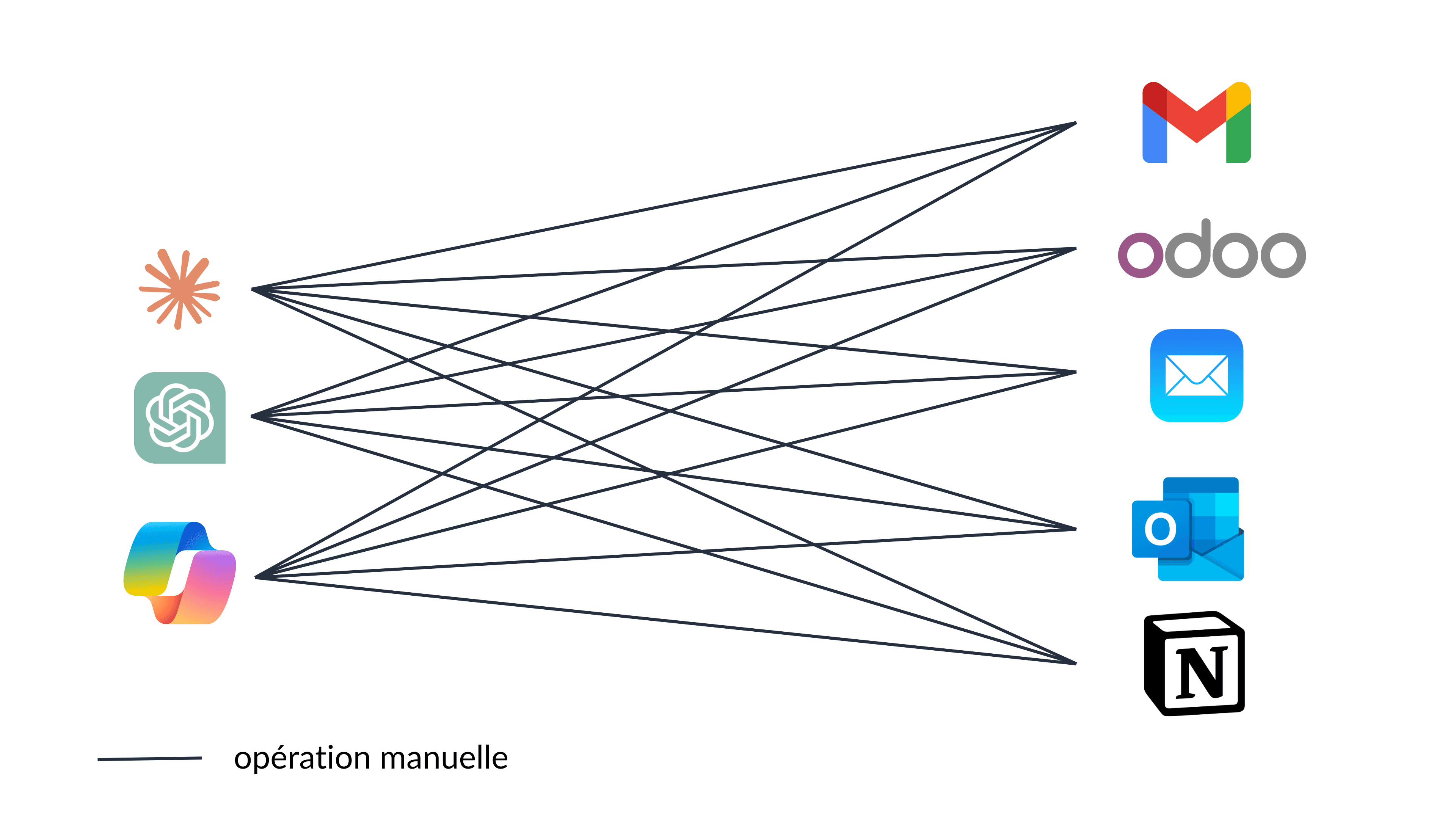
Imagine having to manually connect each tool in your ecosystem (ChatGPT, Claude, your collaborative tools) with each business application (Gmail, Odoo, your messaging, Outlook, Notion). Without MCP, each connection requires a manual operation, creating a real tangle of wires. It's an integration nightmare: dozens of point-to-point connections to maintain, fragmented data flows, and complexity that grows exponentially with each new tool added.
MCP radically changes this equation. Instead of creating individual connections between each pair of tools, MCP acts as a central hub. Each tool only connects once to the MCP protocol, and can then communicate with all other compatible tools, creating a clear and maintainable architecture.
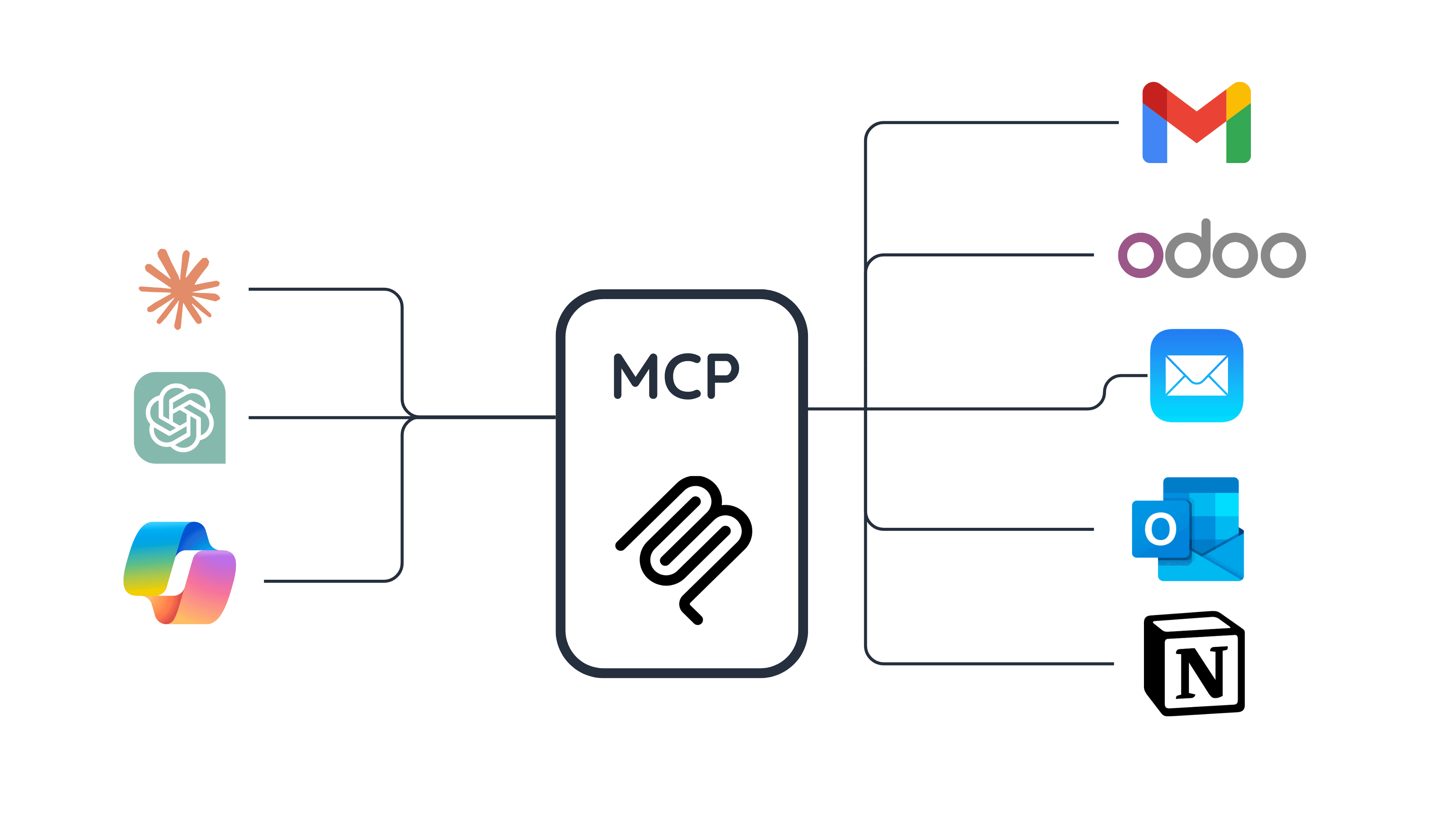
The three key elements of MCP
MCP defines three fundamental elements:
- Resources: what AI can read (documents, databases, histories)
- Tools: what AI can do (create, modify, send, analyze)
- Instructions: how it interacts (procedures, rules, permissions)
Vivian compared this to welcoming a new employee. When Sophie joins the company as a sales manager, she receives onboarding on the procedures necessary for her role, the documents to complete, and the tools to use. Then, on a daily basis, she uses these tools made available to her. MCP works exactly the same way for AI: it gives it access to the resources, tools, and instructions necessary to accomplish its tasks.
Security and permissions
A crucial point: MCP allows secure connection to your systems with real-time data reading and writing, while respecting permissions and security. AI only has access to what you authorize, exactly like an employee.
MCP lays the foundations by connecting AI to your ecosystem. But the real revolution begins when this connected AI becomes capable of orchestrating the actions necessary to achieve an objective itself. This is where agentic AI comes in.
Agentic AI: when AI takes action
The second part of the conference explored an even deeper revolution: agentic AI, capable of acting autonomously.
With agentic AI, the user gives an objective like "Prepare an offer for client Dupont". The AI plans and executes the entire process: analyzes client history, checks inventory, calculates the best price, creates and sends the quote, and schedules a reminder in 3 days.
Scenario 1: Classic AI
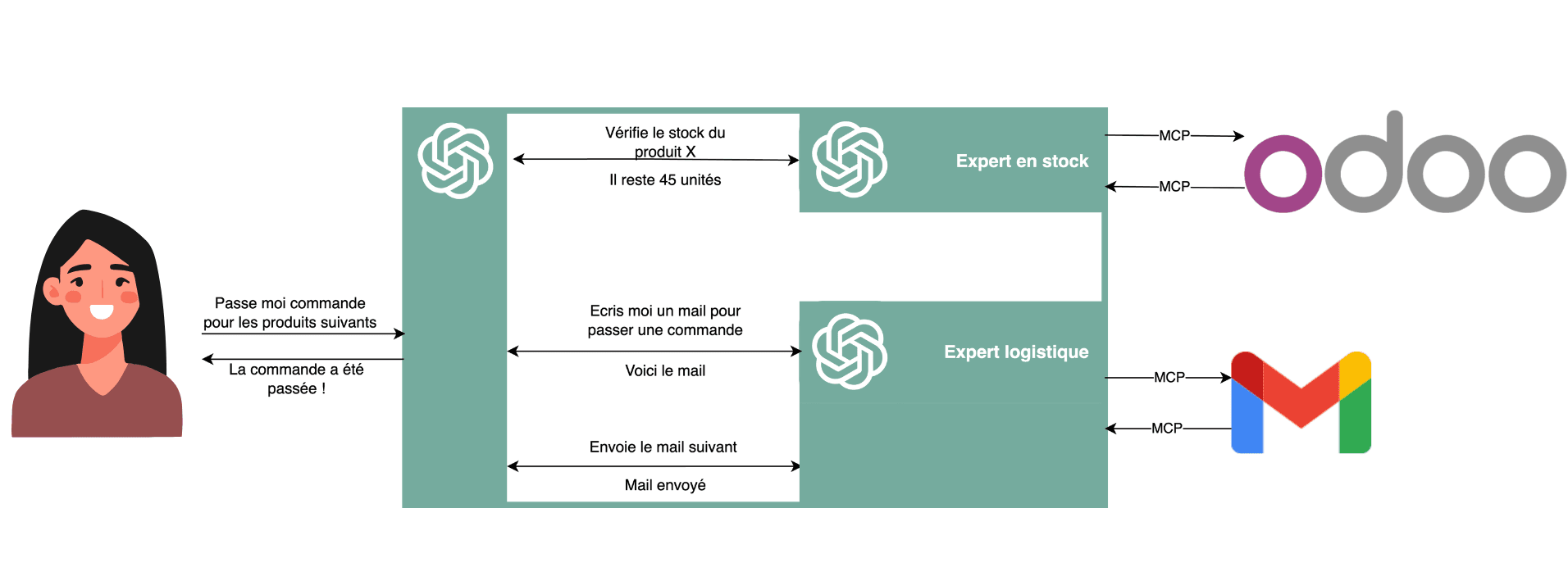
At each step, the user must explicitly formulate the next action. AI is content to respond to requests one by one, without understanding the global objective. It's a sequential process where the human manually orchestrates all the steps. AI does connect external tools (Odoo for inventory, Gmail for email) via MCP, but it only acts on direct instruction.
Scenario 2: Agentic AI
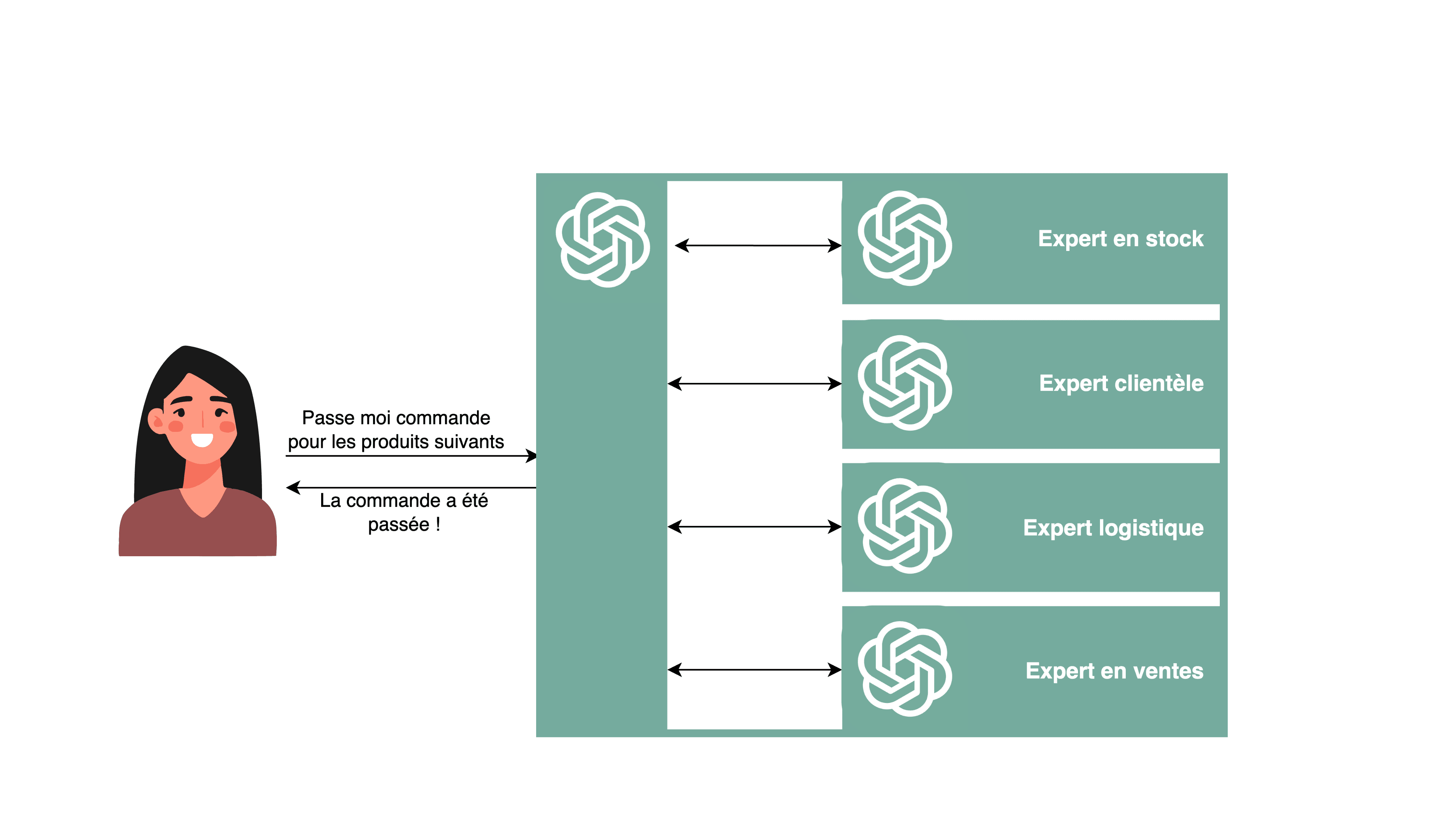
AI understands the global intention and automatically orchestrates a multi-agent system: the inventory expert who checks product availability via Odoo, the customer expert who retrieves client information, the logistics expert who prepares the order, and finally the sales expert who sends the confirmation email via Gmail.
The user simply receives confirmation: "The order has been placed!", without having to guide each step.
The three key capabilities of agentic AI
Agentic AI is distinguished by three fundamental capabilities:
Understanding intention: Not just responding, but understanding the why. For example, "Increase sales" becomes "Identify inactive clients and propose targeted promotions".
Orchestrating actions: Chaining the right steps in the right order. Faced with an urgent order, AI will check inventory, propose an alternative in case of shortage, then negotiate.
Making decisions: Adapting its strategy according to context. When a VIP client is detected, AI automatically applies a discount and escalates to the manager.
Real use cases: our client projects
TenderAI: Public tender automation
This first project addresses a well-known business problem: filling out public tenders is long and tedious. You have to navigate complex legal jargon and identify numerous exclusion clauses.
We designed a multi-agent system that automatically analyzes tenders:
- Agent 1 - Project summary: Produces a clear synthesis of the tender
- Agent 2 - Risk management: Identifies execution, operational, and regulatory risks before commitment
- Agent 3 - Participation conditions: Extracts prerequisites, necessary qualifications, documents to provide, and eligibility criteria
The system monitors RSS feeds and automatically processes new opportunities. The gains are significant: participation in more tenders and complete automation of the initial analysis process.
Speech to Speech Learner: Intelligent voice training
The second project concerns learning software for rules related to a particular profession, requiring very precise and codified vocabulary.
Our multi-agent system offers continuous 24/7 learning:
- Agent 1 - Scenario creation: Scenarios learning in an adapted way
- Agent 2 - Pronunciation correction: Interrupts and corrects the student in real time during pronunciation problems
- Agent 3 - Vocabulary codification: Explains the exact way to pronounce certain words and phrases
The advantages are multiple: learning available continuously, immediate error correction, uniform communication, and the possibility of creating a multitude of different scenarios.
In conclusion
The objective is no longer to ask AI for answers, but to entrust it with objectives to achieve. To move from "Tell me what to do" to "Here's what I want to accomplish, manage the process".
At Necko Technologies, we support companies from idea to operation, combining technological consulting, AI architecture, and development of concrete solutions.
From auditing your processes to putting custom AI solutions into production, we support you at every step.
Ready to explore what agentic AI can do for your business? Contact us!